What Could Federal Changes Mean for Minnesota Special Education?
The recent announcement from the U.S. Department of Education to move special education and civil rights functions to other federal agencies has prompted questions from educators, administrators, and families across Minnesota. While many details remain uncertain, it is important for special education leaders to understand what these changes could mean for our state and local school districts.
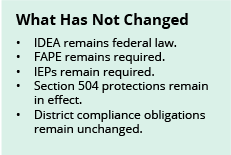 First and foremost, the Individuals with Disabilities Education Act (IDEA), Section 504 of the Rehabilitation Act, and the Americans with Disabilities Act (ADA) remain federal law. School districts would continue to be responsible for providing a free appropriate public education (FAPE), implementing individualized education programs (IEPs), educating students in the least restrictive environment (LRE), and protecting the procedural safeguards afforded to students and families.
The larger question is not whether these responsibilities remain in place—they do. The question is how the federal infrastructure that supports implementation, accountability, and continuous improvement might change.
The Role of Federal Leadership
For the past 50 years, the Office of Special Education Programs (OSEP) within the U.S. Department of Education has provided leadership and oversight for IDEA implementation. OSEP administers IDEA funding, monitors state compliance, oversees State Performance Plans and Annual Performance Reports, funds technical assistance centers, supports personnel preparation programs, and provides guidance to states and school districts.
These activities are often invisible to local educators, yet they form the foundation of the national special education system. They help ensure that students with disabilities receive consistent protections and opportunities, regardless of where they live.
Potential Impacts on Minnesota
If federal special education responsibilities are transferred or significantly restructured, Minnesota could experience several impacts.
Increased Responsibility for the Minnesota Department of Education
Minnesota relies heavily on federal guidance and oversight related to IDEA implementation. A reduction in federal expertise or staffing could require the Minnesota Department of Education (MDE) to assume a greater role in interpreting regulations, developing guidance, supporting districts, and ensuring consistency across the state.
This could cause increased demands on state resources and longer timelines for resolving emerging questions and challenges.
Greater Variability across States and Districts
One of the primary purposes of IDEA was to establish a national framework of protections and expectations for students with disabilities. Federal oversight helps ensure consistency in areas such as evaluations, service delivery, procedural safeguards, and accountability.
If federal guidance and monitoring become less robust, implementation may become more variable across states and potentially across districts. Smaller districts and rural communities could be particularly affected because they often rely on shared expertise and regional support systems.
Changes in Civil Rights Enforcement
Proposals to move civil rights enforcement responsibilities outside the Department of Education could alter how disability discrimination complaints are addressed.
Historically, the Office for Civil Rights (OCR) has provided an education-focused approach to resolving concerns related to Section 504 and disability discrimination. Changes in enforcement structures could result in different complaint processes, longer timelines, or a greater emphasis on legal proceedings rather than technical assistance and early resolution.
Impacts on Technical Assistance and Professional Learning
Federal discretionary grants support many of the technical assistance centers, parent training organizations, personnel preparation programs, and research initiatives that benefit states and local districts.
Minnesota educators regularly benefit from these investments through professional development opportunities, evidence-based practices, leadership development, and implementation supports. Any disruption to these systems could place greater responsibility on state agencies, professional organizations, cooperatives, and local districts to fill those gaps.
Why This Matters for Minnesota Leaders
Minnesota's special education system is facing significant challenges, including workforce shortages, increasing student mental health needs, rising service costs, and ongoing compliance responsibilities. During periods of change, strong collaboration among local districts, cooperatives, professional associations, MDE, and federal partners becomes even more important.
As discussions continue at the federal level, Minnesota leaders may wish to focus on several key questions:
- How will students' rights and protections be preserved?
- How will states receive guidance and technical assistance?
- How will accountability and monitoring responsibilities be maintained?
- How will personnel preparation and workforce development efforts continue?
- How will families access civil rights protections and dispute resolution supports?
Looking Ahead
Regardless of future organizational changes at the federal level, Minnesota schools remain committed to serving students with disabilities and ensuring that every learner has access to the supports and services they need to succeed.
The discussion about the future of federal education leadership is ultimately about more than funding. It is about maintaining the systems, expertise, accountability, and protections that support high-quality special education services for students and families across Minnesota.
Moving the functions of the U.S. Department of Education (DOE) does not remove state obligations under IDEA and Section 504; it risks removing the federal education-specific infrastructure that helps states and districts meet those obligations consistently and effectively.